
Shortlist the 1:24 RC drift car for its smaller listed package footprint and explicit 4WD specification; choose the 1:16 model for window-box presentation and a dual-motor configuration. For wholesale RC car buyers, scale is a range filter—not proof of better drifting. The two catalog versions reviewed on October 17, 2026 differ in styling, control descriptions, and packaging as well as scale, so approve the exact samples before deciding which version belongs in your range.
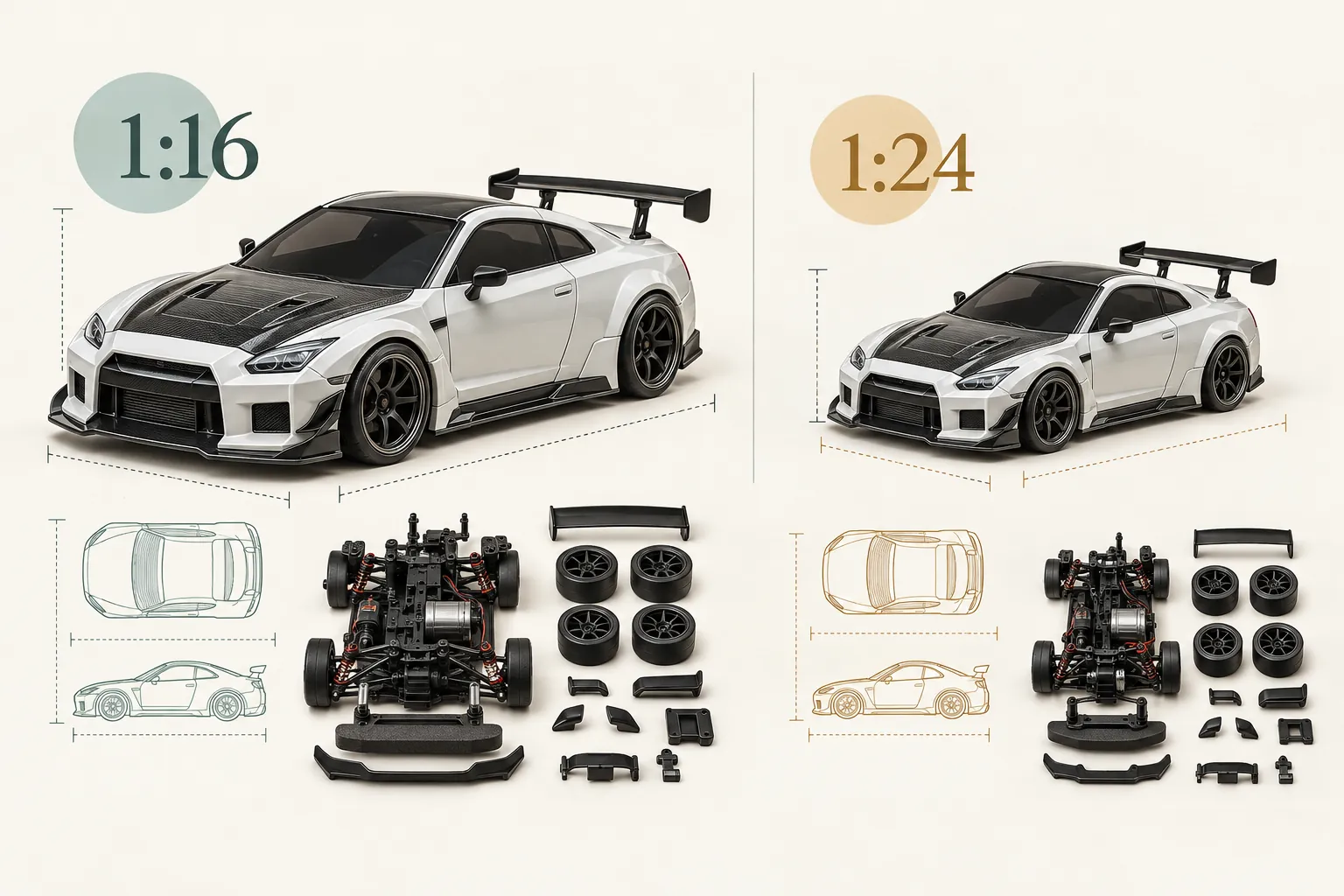
How do the two catalog RC drift cars compare?
| 1:16 Scale RC Drift Car with Dual Motors | Listed scale: 1:16. Listed motor configuration: dual motors. Listed controls: 2.4GHz remote control with forward, backward, left, and right functions. Other listed features: T-Rex styling and LED lights. Retail format: window box. Package dimensions: 28 × 14 × 11 cm. |
|---|---|
| RC Drift Car, 1:24 Scale, 2.4GHz, 4WD | Listed scale: 1:24. Listed drivetrain: 4WD. Listed controls: 2.4GHz, four-channel control, and a left/right steering drift function. Retail-package dimensions: 20.7 × 12.2 × 12.9 cm. Listed shipping-carton dimensions: 64 × 45 × 54.5 cm. |
Does dual motor mean the same thing as 4WD?
Dual motor describes motor count; 4WD describes which wheels receive drive, so the two labels are not interchangeable.
Do not transfer the 1:24 model’s 4WD specification to the 1:16 model simply because the latter lists two motors. Check the driven-wheel arrangement on the selected sample and have it identified on the approved specification.
Both listings specify 2.4GHz, but that frequency alone does not establish proportional steering, throttle response, or drift control. Check whether steering and throttle inputs are progressive or stepped, then operate both sample sets together to assess pairing and unintended cross-control.
This is also a comparison of two different product concepts, not a controlled experiment in scale. T-Rex styling, drive configuration, tires, and control behavior must be assessed separately rather than attributing every difference to 1:16 versus 1:24.
Which listed package fits a tighter retail display?
The 1:24 package has a smaller calculated flat footprint, but its last listed dimension is taller than the 1:16 package’s.
Buyer comparison assumption: treat the first two listed dimensions as the display base and the third as height. Under that orientation, the 1:16 package occupies 28 × 14 = 392 cm², compared with 20.7 × 12.2 = 252.54 cm² for the 1:24 package—approximately 36% less base area. The corresponding heights are 11 cm and 12.9 cm.
Prioritize the 1:24 sample if shelf-base area is your constraint. Favor the 1:16 sample if a window-box presentation is part of the retail brief. For a height-limited display, approve the actual selling orientation before deciding: a smaller scale does not automatically mean a shorter retail pack.
These calculations compare individual packages, not vehicle dimensions, pallet efficiency, or freight cost. Approve the 1:24 box construction and product visibility from the physical retail-pack sample.
What should each sample demonstrate before range approval?
| 1:16 dual-motor model — proposed sample checks | Identify the motor and driven-wheel arrangement. Check forward, reverse, left, and right response; assess whether the observed turning and sliding behavior matches the intended drift-car positioning. Inspect LED operation, T-Rex appearance, window-box visibility, and the physical package dimensions. Record observations against the exact sample version. |
|---|---|
| 1:24 4WD model — proposed sample checks | Confirm the listed 4WD configuration and demonstrate the four-channel functions. Observe steering, throttle response, and the listed drift function during the same maneuver sequence used for the 1:16 sample. Approve the retail-box construction and display orientation, then measure the individual package. Keep shipping-carton measurements separate from retail-pack measurements. |
Which model should enter the range?
Choose the 1:24 model when compact retail packaging and an explicitly listed 4WD configuration lead the brief; choose the 1:16 model when window-box presentation, T-Rex styling, and dual motors are the intended product proposition.
For a range positioned specifically around drifting, make observed sample handling the final selection gate—not the scale label. Request one exact retail-packed sample of each candidate, including its intended controller and power configuration, and attach the approved configuration and packaging to the purchase specification.
Keep speed and runtime out of the comparison unless they are measured for the selected configuration under recorded conditions. Neither a smaller scale nor a dual-motor label is a substitute for that result.