
Control a private-label RC launch by approving the written configuration, checking the first sample against it, and authorizing production and shipment separately. For buyers selecting a private label toys manufacturer, the practical safeguard is a linked record of specifications, sample approval, artwork, changes, and inspection findings—not a sample photo alone. Use the gate-based timeline below to decide what may proceed, what needs correction, and who must approve the next step.
This is a hypothetical purchasing method, not a customer story or a reported order result. The example uses a documented 1:24-scale, 2.4GHz, 4WD RC drift car. Catalog observations are dated; the inspection criteria and decision gates are proposed buyer controls.
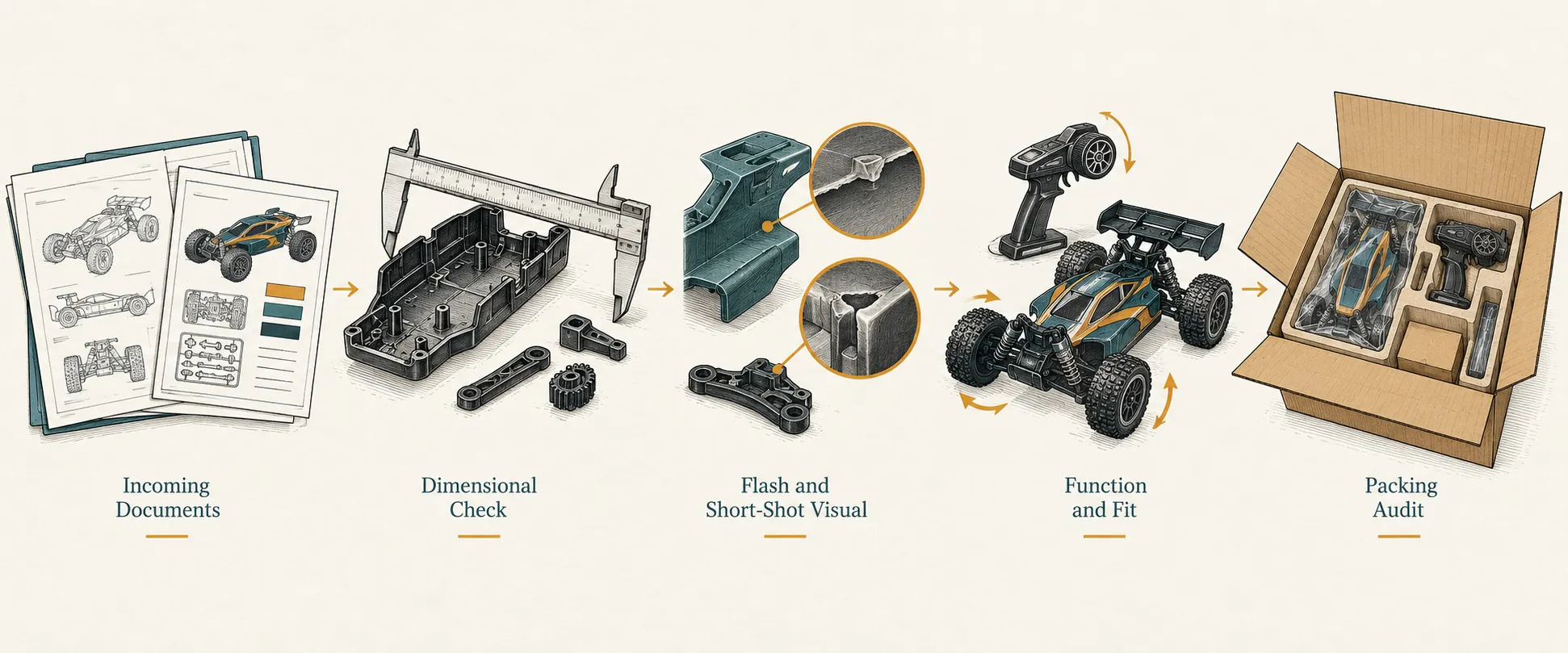
Which RC Car Configuration Is the Starting Reference?
| Listed product | RC Drift Car, 1:24 Scale, 2.4GHz, 4WD. |
|---|---|
| Listed control configuration | The catalog describes four-channel control and a left/right steering drift function. Define the expected response to each control in the order specification. |
| Listed tire options | The catalog describes interchangeable smooth speed tires and drift tires. Confirm the exact tire sets and quantities included in the quoted version. |
| Listed package dimensions | 20.7 × 12.2 × 12.9 cm. Treat these as a catalog reference; agree the dimensions of the actual branded package before approval. |
| Version details to settle | Identify the car and controller versions, power configuration, included accessories, component materials, finish, colors, instructions, and packaging revision in the written specification. |
What Project Timeline Keeps Approvals in the Right Order?
| Gate 1 — Define the version and quote basis | Procurement and the product owner identify the car, controller, power configuration, accessories, destination markets, branding scope, and specification revision. Obtain a quote tied to that scope and the proposed production factory. Resolve configuration differences before authorizing the sample. |
|---|---|
| Gate 2 — Inspect the first sample | Compare the physical sample with the agreed written specification and design requirements. Record discrepancies and obtain corrections or explicitly approved specification changes. Only after acceptance should the sample become the approved production reference. |
| Gate 3 — Approve artwork and the packaged configuration | Brand and procurement approve the relevant print-ready files, color references, placement, instructions, and packaging version. Review a physical decorated or packaged sample where a digital proof cannot establish the required result. |
| Gate 4 — Close evidence and commercial reviews | The designated safety or regulatory owner reviews destination-specific applicability and configuration-matched evidence. Procurement reconciles the quote and order with the approved version. Authorize production only after the required reviews are closed. |
| Gate 5 — Compare production with the approved records | Inspect production units against the written specification, retained approved sample, artwork, and authorized changes. Identify the affected lot and packaging revision for each finding. Complete correction and reinspection where required. |
| Gate 6 — Make a written shipment decision | The named buyer approver reviews inspection findings, corrective actions, quantities, and the separate destination-document checklist. Record precisely which goods are released and which remain on hold. |
What Should the First RC Sample Inspection Record Contain?
The first sample inspection record should connect each observable check to the agreed requirement, the actual finding, and a decision—not simply mark the whole toy “approved.”
Start with the written specification and design requirements. Do not use an unapproved sample as its own acceptance standard. Record the sample identifier, specification revision, reviewer, date, setup, observations, and disposition. The checks below are commercial inspection recommendations; they do not establish regulatory safety.
| Control and drive response | Inspect: pairing, each agreed directional command, steering return, and drift behavior using the agreed surface and tire configuration. Compare: the control-response specification and instructions. Record: the command, observed movement, and test setup. Failure signal: reversed, missing, intermittent, or otherwise incorrect response. Decision: hold functional approval and request correction, then repeat the affected checks. |
|---|---|
| Power configuration and supplied parts | Inspect: visible power-source identification, connectors, compartment fit, controller power provisions, and charging equipment if included. Compare: the agreed component list and operating instructions. Record: identifiers and what was supplied. Failure signal: a different component, incompatible connection, or omitted accessory. Decision: resolve the configuration before approval and route any substitution for evidence review. |
| Materials and assembly | Inspect: visible component markings, tire type, body-panel fit, fasteners, and assembly consistency. Compare: the component specification and supplier declarations. Record: observable identifiers and differences. Failure signal: an unexplained material or construction substitution. Decision: obtain identification and supporting review; appearance or touch alone cannot establish material composition. |
| Finish and decoration | Inspect: color, print alignment, coating coverage, scratches, glue marks, and logo position. Compare: the design requirements, approved color references, and artwork revision. Record: defect location and measured placement where relevant. Failure signal: wrong artwork, color mismatch, or finish outside the agreed criteria. Decision: request a corrected sample or obtain a documented design change. |
| Dimensions and fit | Inspect: the agreed car dimensions, relevant accessory fit, and package dimensions. Compare: the dimensional drawing or specification using the stated measurement method. Record: actual measurements and measurement points. Failure signal: a dimension outside the buyer-agreed tolerance or a fit problem. Decision: correct the item or approve a revised specification before creating the production reference. |
| Pack contents and presentation | Inspect: car, controller, agreed tire sets, other included accessories, instructions, insert fit, and package closure. Compare: the packing list and packaging design. Record: contents and fit observations. Failure signal: missing parts, obstructed presentation, or packaging that does not close as agreed. Decision: correct the packing configuration and review it again. |
How Does a Sample Discrepancy Become a Controlled Decision?
A sample discrepancy should produce a traceable correction or an authorized requirement change before the sample is approved.
For a worked conditional example, suppose the agreed control map says a left command produces left steering, but the sample steers right. Record the sample identifier, controller identifier, specification revision, setup, command, and observed response. Classify the sample as not approved for that requirement. Ask for the corrected configuration, then repeat the steering check and any related checks affected by the correction. This is a hypothetical finding, not a reported product defect.
After acceptance, identify and retain the approved sample alongside its measured features, artwork revision, packaging version, color references, and named approvers. Photographs help locate and explain findings, while the physical reference preserves details such as fit and finish. A missing photograph alone does not invalidate an otherwise traceable review. The sample-control method is supported by the Specification acceptance guide.
Which Artwork and Packaging Decisions Must Be Frozen?
Freeze the files and physical packaging details that determine what production must reproduce, not just the appearance of a digital mockup.
Keep one approval index linking the specification, physical sample, product-decoration file, package artwork, instructions, color references, and approval status. Make clear whether a proof approves text and layout only or also approves physical color, finish, placement, and fit. A screen proof cannot settle every physical attribute.
For this RC example, compare the printed feature claims with the selected car, controller, tire sets, and power configuration. Do not let another catalog version supply the box copy. Open and repack the proposed retail package to check that the agreed contents fit, the instructions remain usable, and the closure works.
Assign an owner to each unresolved decision. Do not treat an unspecified color, accessory, or instruction revision as permission for an unreviewed choice.
How Should Compliance Evidence and Quote Changes Be Reviewed?
Review regulatory applicability for the exact destination and configuration separately from commercial sample acceptance, then reconcile any resulting changes with the quote and order.
Have the importer and designated safety or regulatory specialist confirm the applicable requirements and evidence for the selected product. Match reports and other supporting records to their named entity, model, construction, and scope. A buyer's functional or visual inspection does not certify safety or determine age suitability.
Before accepting a change to a battery, coating, material, or production factory, determine whether the existing evidence still covers the proposed configuration. This is a purchasing control, not a substitute for the applicable laboratory evaluation or specialist judgment. Specification acceptance guide
For each approved change, record the affected specification, sample, artwork, evidence, price, and timing. Obtain revised commercial confirmation where needed. A visually similar substitution is not automatically equivalent, and a written change request is not itself approval.
What Must Bulk Inspection Confirm Before Shipment?
Bulk inspection must confirm that the identified production goods match the agreed specification, approved reference, artwork, and authorized changes before shipment is released.
Repeat the relevant function, appearance, measurement, and packing checks on production units under an agreed inspection plan. Set the selection method, coverage, acceptance criteria, and escalation rules before inspection; any buyer-defined screening counts or tolerances are commercial criteria, not compliance standards or predictions of return rates.
Record the order and version, production lot or carton range, units examined, findings, and disposition. The retained sample complements the written requirements and change history—it does not replace them. Check product and package revision identifiers as carefully as the visible logo.
When a discrepancy appears, identify the potentially affected goods, hold them from release, and assess whether a shared component or process could widen the scope. Document the correction and reinspection. Release unaffected goods separately only when their acceptance is confirmed and the agreed commercial arrangements allow it.
Keep destination-specific paperwork on a separate checklist. The shipment approval should name the accepted goods and quantities, unresolved holds, approver, and date; it should not imply approval of the entire order when only part has been accepted.
Private-Label RC Launch Risk Register
| Configuration drift | Signal: the sample, quote, and specification identify different controllers, tire sets, or power components. Owner: product lead and procurement. Decision: hold version approval and reconcile the records before sampling or production proceeds. |
|---|---|
| Sample accepted with an unresolved function | Signal: a control response is incorrect, intermittent, or not evaluated under the agreed setup. Owner: product reviewer. Decision: record the finding, obtain correction, and repeat the affected checks before approval. |
| Artwork approved against the wrong version | Signal: package claims or pictured contents differ from the selected configuration. Owner: brand lead. Decision: stop artwork release, correct the files, and approve the replacement revision. |
| Unreviewed substitution | Signal: a component, material, coating, or factory differs from the approved record. Owner: procurement with the safety or regulatory specialist. Decision: assess sample, evidence, cost, and timing implications in writing before accepting the change. |
| Approval scope is unclear | Signal: a message says “approved” without identifying the sample, file revision, or attributes covered. Owner: project lead. Decision: clarify the approval scope and update the index; do not assume a layout approval also approves function or physical finish. |
| Production mismatch | Signal: inspected units differ from an agreed requirement or authorized reference. Owner: quality reviewer. Decision: identify affected goods, require corrective action, and close reinspection before release. |
| Shipment released beyond the inspected scope | Signal: release approval omits quantities, versions, or lot boundaries. Owner: buyer shipment approver. Decision: issue a scope-specific release and keep unresolved goods on hold. |