
For US and EU toy buyers sourcing directly from manufacturers or through trading companies, use a weighted toy supplier scorecard tied to the destination market, exact toy configuration and purchasing route—not the sales presentation. Score specification control, sample accuracy, document scope, inspection response, packing data, communication and issue handling against buyer-held records. Keep evidence confidence separate from the numerical score, and do not let a strong total override an unresolved product, document or inspection acceptance condition.
The framework below is a proposed purchasing method, not a compliance standard or a measured predictor of delivery, sales or returns. Apply the same requests, scoring anchors and acceptance criteria to every supplier being compared.
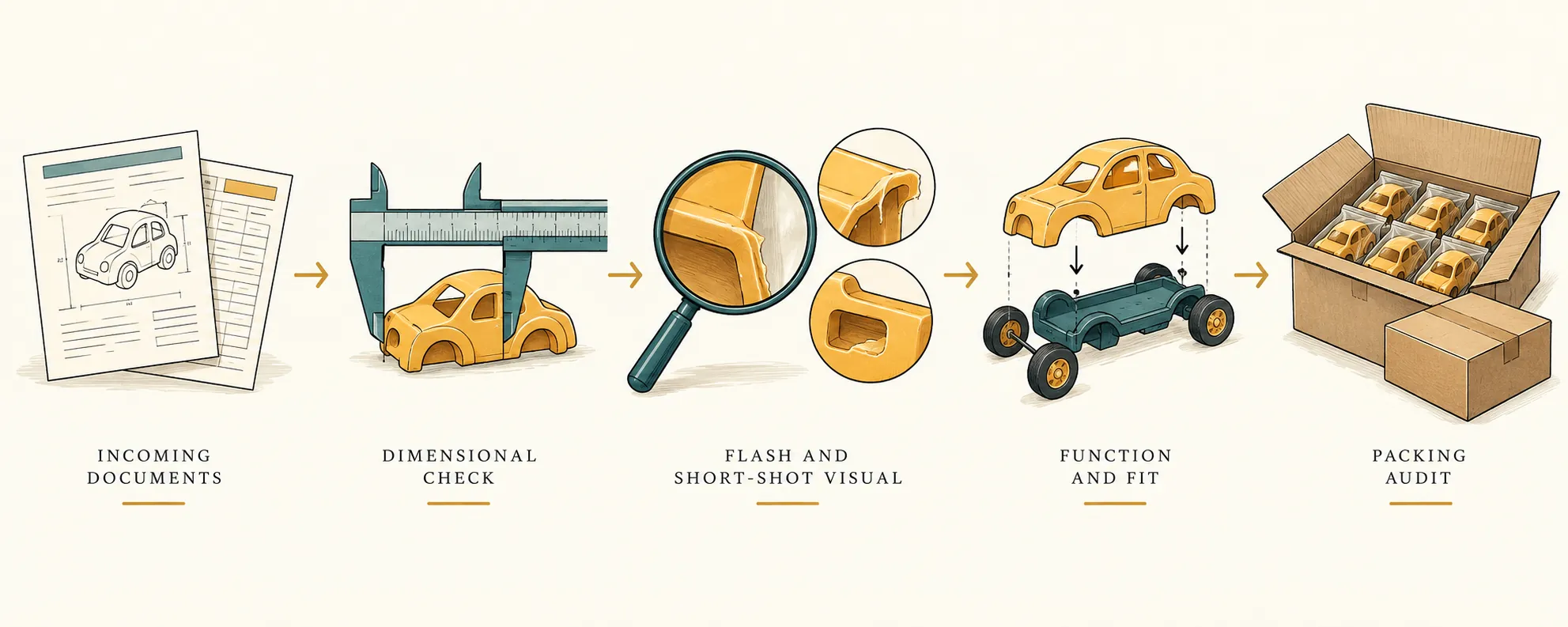
What must buyers define before comparing toy suppliers?
Define the destination market, assortment and sourcing responsibilities before awarding points; otherwise, suppliers may be answering different buying briefs.
Record the country of sale, sales channel, selected toy model and version, proposed age labeling for review, included accessories, packaging language and replenishment needs. Identify the contracting entity and who controls specifications, arranges sampling, coordinates inspection and handles claims. A trading-company route is not, by itself, evidence of weaker QC; evaluate the records and control process.
Choose samples that cover materially different configurations in the proposed assortment. For a toy set, compare the actual piece mix and packed contents. For a powered toy, include its stated functions, controls and supplied accessories in the review. These are suggested selection criteria, not a universal sample count.
For repeat orders, request written confirmation of how the approved version will be preserved, how substitutions will be authorized and when the supplier will confirm replenishment availability and timing. Treat a quoted schedule as a commitment to evaluate, not proof of past delivery performance.
Which records should carry weight in a toy supplier scorecard?
| Specification control — 20 points | Request: A dated specification for the exact model and version, covering stated materials and functions, accessories, packaging, labels and carton marks. Sales-only response: “Same as the picture” or “standard export version.” Acceptable record: A revision-controlled specification, linked to the quotation and approved sample, with written approval required for substitutions. Decision: Award full credit only when the order configuration and change-approval process are explicit. This establishes what the supplier is being asked to deliver. |
|---|---|
| Sample accuracy — 20 points | Request: A sample review against the proposed order specification and assortment requirements. Sales-only response: A demonstration video without a traceable sample identity. Acceptable record: An identified approval sample, dated photographs, an accessory checklist, function observations and a resolved deviation list. Decision: Accept the sample only after differences are approved or corrected. The record connects the physical toy to the purchasing specification; it is not a substitute for safety testing. |
| Document scope — 20 points | Request: Product documents relevant to the destination market and selected configuration. Sales-only response: “All products are certified,” supported only by a logo or an unrelated report. Acceptable record: Complete documents whose model references, photographs, construction, named entities and stated scope can be reconciled with the selected toy. Decision: Resolve unexplained differences before treating a document as support for the item. A report for another model or configuration does not establish compliance for the selected toy. |
| Inspection response — 15 points | Request: Written agreement on inspection scope, access, acceptance criteria and handling of findings. Sales-only response: “Our QC checks everything.” Acceptable record: A confirmed inspection plan tied to the order, plus documented disposition and recheck evidence for findings when an inspection occurs. Decision: Score the agreed process before ordering and actual execution afterward. This distinguishes willingness to discuss QC from a record of responding to an inspection. |
| Packing data — 10 points | Request: Unit packaging, contents per pack, carton quantity, external dimensions, weights and carton marks for the quoted configuration. Sales-only response: A catalog packing line presented as final shipment data. Acceptable record: A dated packing specification, supported by measurements or photographs and reconciled with the approved pack. Decision: Use confirmed data for logistics planning and resolve conflicting figures. Carton quantity alone does not establish an order-multiple requirement. |
| Communication — 5 points | Request: A named contact, agreed response expectations and written answers to numbered product and order questions. Sales-only response: Quick reassurance that leaves the questions unanswered. Acceptable record: A correspondence log showing answer completeness, revision acknowledgment, escalation and updates against agreed dates. Decision: Score clarity and follow-through, not friendliness alone. A slow response is a communication observation, not proof of fraud or worse behavior after payment. |
| Issue handling — 10 points | Request: Written ownership, escalation and proposed commercial treatment of shortages, damage or specification deviations. Sales-only response: “We will take care of any problem.” Acceptable record: Agreed issue-handling terms and, when an issue occurs, buyer-held records of containment, corrective action, disposition and closure. Decision: Distinguish an agreed procedure from demonstrated execution. Do not award proven-performance credit merely because a procedure exists. |
How should buyers calculate scores and attach evidence links?
Calculate each category as its weight multiplied by its rating divided by four, then add the category results for a total out of 100.
Use these proposed rating anchors consistently: 0 = the requested condition is not demonstrated; 1 = a statement or generic document only; 2 = an item-specific response with unresolved acceptance points; 3 = complete, consistent records meeting the agreed pre-order criteria; 4 = those controls have also been demonstrated through a relevant buyer-observed transaction or inspection.
A first-time supplier can satisfy pre-order criteria without having a transaction history with the buyer. Keep that distinction visible rather than turning lack of history into an allegation about capability.
In the working scorecard, hyperlink the actual files held by the buyer. Link directly to the approved specification, sample review, relevant report pages, inspection record or correspondence—not to a supplier homepage. Keep the document date and revision beside the link so a later replacement does not silently change the basis of the decision.
What belongs in each scored evidence entry?
| Identity and scope | Supplier legal entity; destination market; sourcing route; toy model and version; quotation or order reference. |
|---|---|
| Request and response | Category; weight; exact buyer request; supplier response date; stated acceptance criterion. |
| Evidence link | Clickable buyer-held file link; document title; date and revision; relevant page, photograph or inspection finding. |
| Assessment | Rating from 0 to 4; weighted points; confidence level; short explanation of what the linked record establishes. |
| Decision and follow-up | Accept, conditional acceptance or hold; unresolved condition; responsible person; agreed review date. |
How should confidence levels differ from supplier scores?
Confidence describes how strongly the evidence supports a rating; it does not describe how good the supplier is.
Use High when directly reviewed, item-specific records agree with the relevant sample or buyer-observed activity. Use Medium when item-specific written records are consistent but execution has not yet been observed. Use Low when the assessment relies mainly on declarations, catalog descriptions or records that have not been reconciled with the selected configuration.
Keep confidence at category level. A supplier may have high-confidence packing measurements and low-confidence issue-handling performance. Do not hide that difference inside an average.
For an initial comparison, report the total score alongside the number of categories at each confidence level and identify any hold condition. A high-confidence low score can justify rejection; a high score based largely on declarations calls for further checks, not automatic approval.
How do buyers distinguish claims, observations and official rules?
Label each record by what it actually is so that a sales statement cannot quietly become a verified product fact.
Company statement: A supplier's description of materials, functions, inspection practices or service terms. Record who made it and when, then compare it with the applicable specification or observed activity.
Dated catalog observation: What a listing showed on a particular date. Use it to frame a request, not to establish current stock, production capacity, safety status or shipment-ready packing.
Official rule: Applicable legal text or regulator guidance, identified by market, covered product and relevant dates. Keep legal applicability separate from a supplier's document checklist. A retailer's vendor manual remains that retailer's acceptance policy, not a universal legal requirement.
Buyer criterion or assumption: The weights, rating anchors, response expectations and proposed inspection checks selected for this purchase. Mark assumptions for confirmation and do not present purchasing preferences as statutory requirements.
When should a supplier score lead to approval, a hold or rejection?
Use the score to compare supplier fit, but use explicit acceptance conditions to decide whether the selected toy can move to the next purchasing stage.
Approve the next stage when its agreed criteria are met and the decision is supported by linked records. Use conditional acceptance for a clearly bounded commercial or administrative item with an owner and resolution date. Hold when the ordered configuration is unsettled, the sample differs without approval, product-document scope cannot be reconciled or an inspection finding remains unresolved.
Classify issues before deducting points. A document-administration delay and a recurring product defect are not equivalent; generic procurement guidance likewise recommends separating minor documentation issues from critical nonconformities. This is scoring advice, not a toy safety rule. Kodiak Hub
Reject a candidate when it does not meet a predeclared acceptance condition for the purchase, and record the specific reason. Avoid conclusions about dishonesty or future behavior that the records do not support.
Refresh the relevant categories after a specification change, sample revision, inspection or issue closure. For replenishment, compare the new order with the approved baseline rather than carrying forward an old score unchanged. The useful outcome is a documented purchasing decision—not a permanent supplier ranking.