
To import toys from China, build an order brief that connects the destination market and sales channel to an exact product version, approved sample, document review, inspection plan, and shipment handover. Give every stage a named decision owner and a written release condition. The practical outcome is a controlled purchasing instruction: the supplier knows what to quote and produce, while the buyer knows what must be approved before the order moves forward.
Use the stages below as a recommended purchasing workflow. Assign actual people to each role, agree responsibilities with the supplier and service providers, and keep buyer assumptions separate from confirmed commitments. A target date is a planning input—not an accepted delivery promise.
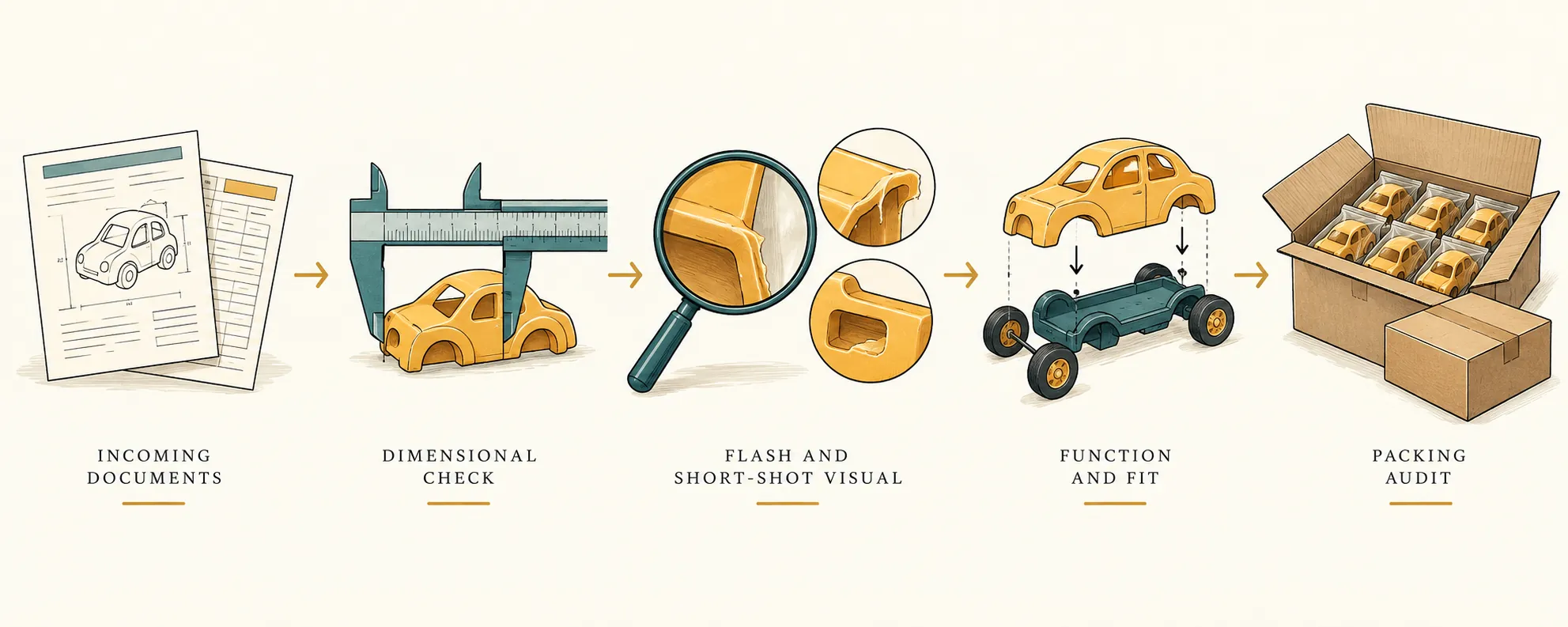
What market and channel decisions must the buyer make first?
The buyer should define the destination country, sales channel, intended user, and commercial constraints before requesting a product shortlist.
Open the brief with these fields: project name and revision; destination countries; importer or purchasing entity; retail, wholesale, or online channel; intended age group for assessment; proposed play activity; quantity by item and variant; target purchase-price band; packaging needs; and required arrival date. Separate the arrival target from the proposed production-completion and shipment dates.
Describe the intended use in plain language. “A remote-controlled toy for an online assortment” gives the sourcing team a clearer starting point than “an innovative bestseller.” Treat the proposed age group as a review input, not proof that a product is suitable for that age.
Decision owner: the buyer's commercial lead approves the market, channel, budget, and quantity assumptions. The compliance lead reviews the intended user and use. Gate: authorize sourcing only when these inputs are recorded; unresolved assumptions remain visibly marked as proposed.
How should the shortlist become a comparable quotation request?
Shortlist products against the same written requirements, then request quotations that identify the exact version and commercial scope.
For each candidate, record a product reference or reference images, the required functions, included accessories, proposed variants, packaging format, and customization requests. Have the supplier identify differences between the reference and the version being quoted. Similar photographs are not a sufficient product definition.
Request quantity by variant, minimum order quantity, any explicit order-multiple restriction, unit-price basis, sample charges, customization charges, payment milestones, preferred trade terms, named delivery place, and proposed timing. Ask for packaging, testing, inspection, and shipment costs to be identified as included, excluded, or separately quoted. A carton packing quantity should not be treated as an order multiple unless that restriction is expressly agreed.
The sourcing lead owns the comparison; the supplier confirms the offered configuration and terms. Release a candidate for sampling only after the buyer can distinguish confirmed details from assumptions and exclusions. Do not select solely on a headline unit price that covers a different package or accessory set.
What must sample approval actually approve?
Sample approval should identify the exact product configuration and the features accepted for production, rather than simply record that a sample was received.
Give the sample a reference, date, and revision. Record its dimensions, components, accessories, controls, markings, packaging, and observable functions. For a remote-controlled toy, for example, write separate checks for each agreed control and demonstration function instead of accepting “works normally” as the entire review.
State the sample's purpose. An appearance sample may approve color and artwork without approving functions or production construction. A packaging mock-up may approve layout without approving the final printed box. Photograph the reviewed version and record every deviation that must be corrected.
Decision owner: the product lead approves the play format and presentation; quality staff record specification deviations; the compliance lead determines the safety-review and testing scope. Gate: issue a dated approval with accepted features, required corrections, and any remaining restrictions. Commercial sample approval is not a substitute for safety testing.
Which details belong in the written production specification?
The production specification should translate the approved sample into measurable requirements that the supplier and inspector can both use.
Include the product reference and revision, construction and component descriptions, dimensions and agreed tolerances, variant allocation, accessory list, function checklist, power arrangement where relevant, and approved sample reference. Attach the artwork files, instructions, required languages, label layouts, retail packaging details, carton packing arrangement, and shipping marks.
Make acceptance criteria concrete. Replace “good printing” with the approved artwork revision and agreed checks for text, placement, readability, and visible damage. Replace “complete set” with an itemized contents list. Where a buyer proposes a functional check or cycle count, label it as a purchasing criterion—not a compliance standard or a prediction of returns.
The buyer's product and quality leads own the specification; the supplier confirms it can produce the agreed version. Gate: approve the production revision and commercial terms in writing before authorizing production. Later changes to components, functions, artwork, or packaging should receive a recorded impact review and approval.
How does standard packaging compare with a private-label box?
Choose existing packaging if it meets the approved channel requirements; choose a private-label box when brand presentation is necessary and the buyer can approve the additional artwork and packaging work.
Consider a hypothetical brief for the same remote-controlled toy, holding quantity, destination, channel, and toy construction constant. The comparison changes only the retail packaging. It is a proposed purchasing exercise, not a supplier offer or a completed customer project.
Existing packaging route: obtain the actual box images and dimensions, contents presentation, instructions, and label layouts. The buyer still reviews suitability for the intended market and channel. Existing packaging does not remove the document-review gate.
Private-label route: add buyer-owned artwork files, print specifications, barcode placement, instruction revisions, and packaging-sample approval. Request the proposed cost and schedule effects rather than assuming they match the existing-box quotation. Ask whether the change affects carton packing or product protection.
The product lead selects the route, the compliance lead reviews relevant text and markings, and procurement accepts the revised commercial terms. Release the chosen route only when its packaging revision is attached to the order brief. Approval of the toy alone does not approve a redesigned box.
How should the buyer review documents before shipment?
Document review should connect each report, certificate, declaration, and label approval to the selected product configuration and destination market.
Create a document register with the document title, issuer, date, named entity, model or product identification, covered construction, applicable market, reviewer, and review status. Have the buyer's compliance lead establish the applicable rules and required evidence for the destination, intended user, and product features. Do not copy one market's checklist into every order.
Compare report descriptions and photographs with the approved sample and specification. Review whether the selected components, accessories, power arrangement, and variants fall within the document's scope. Where coverage needs clarification, obtain a determination from the laboratory or qualified compliance adviser before treating it as accepted. Neither a supplier logo nor a generic certificate title establishes coverage.
Decision owner: the compliance lead accepts the product-document package; the broker reviews the customs data and filing arrangements within its assigned scope. Gate: close the document register with written review outcomes and resolve discrepancies affecting release. Do not use a blanket rule that every internal item code needs a new report or that every report expires after the same interval.
What inspection scope should be agreed before production ends?
Agree an inspection instruction tied to the approved specification before the goods are ready, and name the buyer who will decide whether findings permit shipment.
Specify the order and variant quantities, inspection stage, sampling approach, defect classifications, acceptance criteria, and reporting format. Include checks for identity, assortment, accessories, agreed functions, appearance, dimensions, packaging, instructions, labels, carton quantities, and shipping marks as relevant to the order.
State how each check will be performed. If a function requires a controller, batteries, a charging accessory, or a particular setup, include that setup in the instruction. Define any proposed dimensional tolerance or operating-cycle check as a buyer-agreed inspection criterion. Do not represent routine inspection as a replacement for laboratory safety testing.
The quality lead owns the inspection instruction; the inspector records findings; the supplier addresses agreed corrections. The buyer's authorized release owner decides whether to accept, hold, require correction, or request reinspection. An inspector's visit alone is not shipment approval.
What must be signed off at shipment handover?
Shipment handover should occur only after a named buyer release owner has accepted the product, document, inspection, and logistics status against the agreed order brief.
Record the agreed trade term, its version and named place, booking party, handover location, consignee, destination, and responsibility for each transport leg. Have the forwarder assess the actual cargo configuration, including batteries, magnets, liquids, or other relevant components, rather than relying on the description “toys.”
Reconcile the commercial invoice, packing list, actual item and carton quantities, weights and dimensions, shipping marks, and transport instructions. Have the broker confirm the classification, valuation inputs, applicable charges, required filings, and deadlines for the actual shipment. Keep these determinations separate from the supplier's product quotation.
Decision owners: the supplier prepares the agreed goods and export information; the forwarder manages the assigned transport activities; the broker manages its agreed customs work; the buyer authorizes release. Gate: retain the final specification, approvals, reviewed documents, inspection disposition, and shipment instructions under one order revision. Any material change after release goes back to the affected approver before handover proceeds.