
Approve an RC toy sample only after its controller, power configuration, functions, and pack contents match the agreed written specification and design requirements. Use this RC toy sample checklist to record what was supplied, how it behaved, and whether each check passed, failed, or remains untested. Resolve approval-blocking questions before signing off; then identify and retain the approved sample as a production reference alongside the specification and change records—not as a replacement for them.
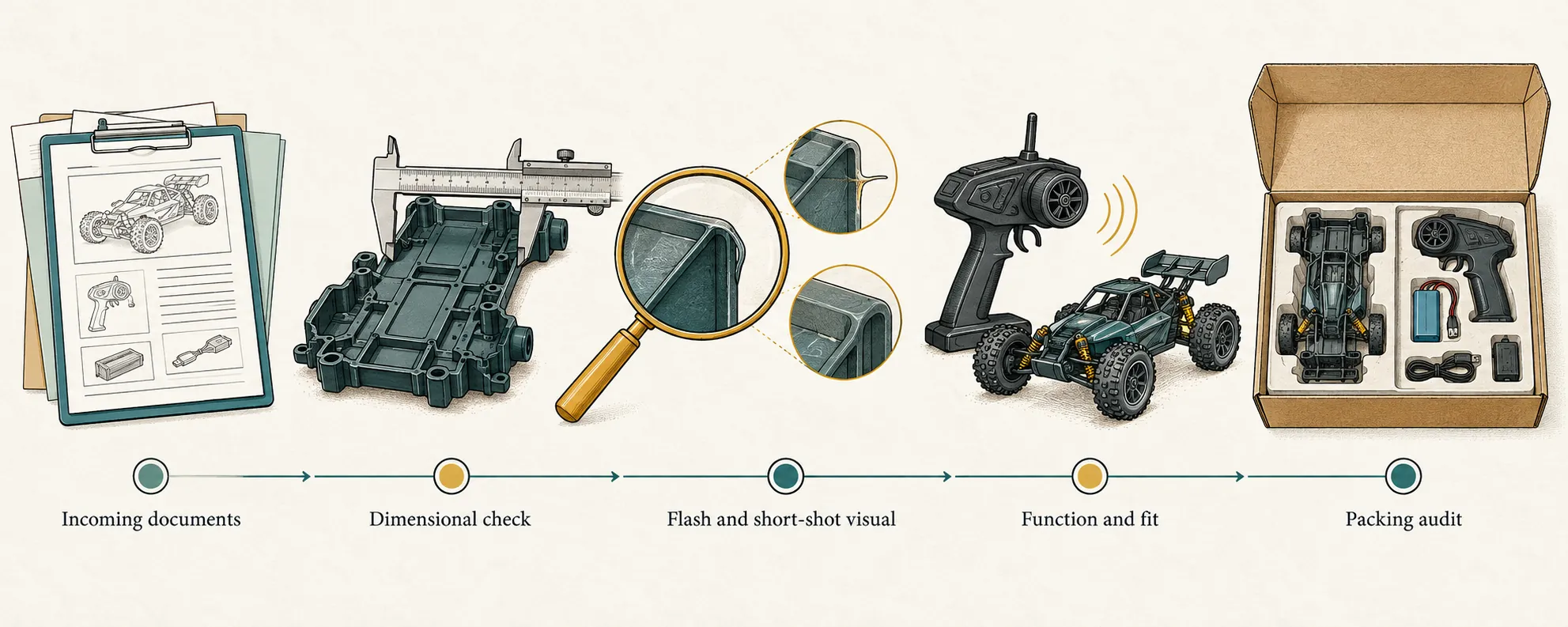
What should an RC toy sample inspection form record?
| 1. Version and initial pack inventory | Compare with: quote, specification, packing list, and artwork. Record: model/version markings, actual contents and quantities, and condition on arrival ____. Failure signal: wrong variant, missing item, or damaged contents. Next decision: identify the discrepancy before setup. Result: [ ] Pass [ ] Fail [ ] Not tested. Open question: ____. |
|---|---|
| 2. Materials, finish, and dimensions | Compare with: agreed material specification, drawings, finish requirements, and dimension limits. Record: accessible component markings, body and tire appearance, coating or print finish, fit, and measured product dimensions ____. Failure signal: mismatched finish, cracks, loose trim, rubbing parts, or dimensions outside agreed limits. Next decision: request correction or technical confirmation; do not infer material composition from touch alone. Result: [ ] Pass [ ] Fail [ ] Not tested. Open question: ____. |
| 3. Instructions before operation | Compare with: agreed instruction revision and language requirements. Record: instructions for battery installation, charging, pairing, controls, shutdown, and accessory changes ____. Failure signal: instructions describe a different controller, connector, or function. Next decision: obtain corrected instructions before attempting an unclear operation. Result: [ ] Pass [ ] Fail [ ] Not tested. Open question: ____. |
| 4. Vehicle and controller power | Compare with: quoted battery and power configuration. Record separately for vehicle and controller: battery type, marked voltage and capacity where applicable, quantity, connector, polarity markings, included/not included status, compartment closure, and switch operation ____. Failure signal: configuration mismatch, damaged contacts, insecure closure, or unreliable switching. Next decision: hold the affected power check for correction. Result: [ ] Pass [ ] Fail [ ] Not tested. Open question: ____. |
| 5. Charging arrangement | Compare with: specified battery, charging device or cable, and operating instructions. Record: supplied cable/device identification, connector fit, input/output markings where applicable, charge indication, elapsed time, and completion indication ____. Failure signal: incompatible parts, damaged connectors, or behavior inconsistent with instructions. Next decision: stop an abnormal charge and request technical review; do not improvise a charger. Result: [ ] Pass [ ] Fail [ ] Not tested. Open question: ____. |
| 6. Pairing and controller response | Compare with: specified controller, pairing sequence, and control map. Record: setup sequence, pairing indication, response to each control, interruptions, and behavior after restarting as instructed ____. Failure signal: failure to pair, unintended response, or intermittent command response under recorded conditions. Next decision: check setup, then repeat the affected check and retain both results. Result: [ ] Pass [ ] Fail [ ] Not tested. Open question: ____. |
| 7. Steering, drive, and neutral | Compare with: agreed direction mapping, steering type, trim features, and drive functions. Record: left/right response, forward/reverse response where specified, return to neutral, straight-running behavior, and wheel rubbing or binding ____. Failure signal: reversed commands, uncommanded movement, sticking, or a promised control function that does not operate. Next decision: distinguish an allowed setup adjustment from a product discrepancy, then retest. Result: [ ] Pass [ ] Fail [ ] Not tested. Open question: ____. |
| 8. Version-specific functions | Compare with: the exact function list in the agreed specification. Record each promised mode separately, including its activation method and observed result ____. Failure signal: absent mode, incorrect sequence, or function inconsistent with the quoted version. Next decision: request correction or explicitly agree a revised version before approval. Result: [ ] Pass [ ] Fail [ ] Not tested. Open question: ____. |
| 9. Accessories and replacement parts | Compare with: itemized pack list. Record: actual quantities, identification, condition, and fit of promised cables, tire sets, tools, or other accessories ____. Failure signal: missing, incorrect, damaged, or incompatible accessory. Next decision: obtain the correct item and complete any dependent functional check. Result: [ ] Pass [ ] Fail [ ] Not tested. Open question: ____. |
| 10. Retail packaging and repacking | Compare with: agreed packaging design, dimensions, labels, and packing arrangement. Record: measured retail-package dimensions, artwork version, placement of contents, product restraint, closure, and instruction inclusion ____. Failure signal: wrong artwork or size, contents rubbing or moving excessively, or inability to repack as intended. Next decision: correct the packaging and recheck fit with the complete contents. Result: [ ] Pass [ ] Fail [ ] Not tested. Open question: ____. |
| Approval and follow-up | Overall decision: [ ] Approved [ ] Hold for clarification or correction [ ] Replacement sample required. Discrepancy IDs ____; responsible party ____; agreed action ____; retest result ____; approving person/date ____; retained reference ID and location ____. |
How should controller and power checks be run consistently?
Run the sample according to its own instructions, while recording the conditions needed to reproduce the result. Note the battery condition, installed tires, surface, controller settings, and operating distance. A statement such as “steering failed” is less useful than a record identifying the command, observed response, and setup.
Check power switches, accessible moving parts, and included accessories before judging the complete operating sequence. These are also checks recommended in the general QCADVISOR checklist; they are inspection guidance, not a safety certification procedure.
Judge proportional steering only when proportional control is specified. For such a system, compare gentle input with fuller input rather than merely checking whether the wheels turn. Where throttle trim is fitted, check that the vehicle remains motionless at neutral on a level surface after adjustment. These setup principles are described in the RC controller setup guide, but should not be imposed on a toy with a different control design.
If a command runs in the wrong direction, check the documented settings. Use channel reversing only if that feature is fitted and the instructions permit it. Record any adjustment; a corrected setting and an unresolved hardware fault are different findings.
Charging observations should distinguish the battery marking, the charging arrangement, and actual elapsed time. Do not treat a brief successful power-on as a runtime test. Stop operation or charging if there is smoke, swelling, damaged wiring, or abnormal heating, and refer the sample for technical review rather than continuing the check.
How does the 1:24 RC drift car illustrate a version-specific check?
The RC Drift Car, 1:24 Scale, 2.4GHz, 4WD provides a concrete example of turning catalog descriptions into separate inspection lines—not treating the listing as proof of sample performance.
Dated catalog observation: the record reviewed on October 17, 2026 identifies the car as 1:24 scale, 2.4GHz, and 4WD, lists left/right steering and drift functionality, and gives retail-package dimensions of 20.7 × 12.2 × 12.9 cm. These are catalog descriptions for that version, not measured inspection results.
Worked check: if the current written specification adopts that package size, enter it as the expected value, add the agreed measurement tolerance, and measure the supplied retail package using a consistent orientation. Record actual dimensions. An out-of-tolerance result triggers a packaging correction or a written specification change, followed by review—not an automatic pass because the car fits inside.
For the control and drive claims, identify the controller and compare its markings and documented configuration with the agreed 2.4GHz version. Record left/right command response and the agreed drift setup separately. A successful pairing does not establish radio conformity, and four wheels turning during movement does not by itself verify a four-wheel-drive construction.
Buyer-defined criteria: agree the drift-test surface, tire configuration, maneuver, and acceptance conditions before testing. Record the battery and included accessories from the quote and physical sample; do not borrow battery details or pack contents from a similar-looking model. Any proposed repeat count or measurement tolerance is a purchasing criterion, not a legal standard or a predictor of returns.
What happens after a discrepancy or an untested check?
A discrepancy should produce a traceable correction decision and a targeted retest before the affected requirement is approved. Keep the original observation rather than overwriting it after an adjustment.
Give each issue an identifier and record the requirement, actual finding, affected component, requested action, and closure evidence. A missing accessory calls for completing the pack and any dependent checks; a controller change can require revisiting pairing, functions, instructions, and packaging fit. An untested function remains untested until it is checked or formally removed from the agreed scope.
Photographs and short videos can clarify finish defects or control behavior, but a missing photograph alone does not invalidate a review supported by clear measurements and observations. Avoid approving unresolved questions that affect the selected version, operation, or pack completeness.
Only after first-sample approval should the sample be labeled and retained as the approved production reference. Bulk inspection is the next stage: compare production with the current written specification, approved design and packaging requirements, retained reference, and authorized change records.
Does a passed sample inspection establish safety or compliance?
A passed sample inspection establishes only that the recorded checks met their agreed criteria; it does not certify regulatory safety, determine age suitability, or demonstrate production-wide conformity.
Keep destination-specific document review and applicable laboratory testing separate from this functional and visual inspection record. Material composition, radio characteristics, and other technical safety conclusions need the appropriate evidence for the actual construction and configuration—not a buyer’s hand check.